Best Keyword Cannibalization Tools (2026 Comparison)
An honest comparison of the best keyword cannibalization tools — the detection method each uses, signup walls, keyword limits, and which one fits your workflow.
· · 7 min read
On this page
There are two very different things people mean by a "cannibalization tool," and most roundups blur them together. Some tools read your Google Search Console data and tell you which of your pages actually compete on real impressions. Others crawl the SERP and estimate overlap from ranking similarity. They answer different questions, and the right pick depends on which one you're asking. This is an honest comparison of the best keyword cannibalization tools on that basis — method first, marketing second — so you can match a tool to your workflow instead of just grabbing whichever ranks highest for "free."
What actually makes a cannibalization tool good?
Before the list, the criteria. A cannibalization tool is only as good as its detection method and how fast it gets you to an answer:
- Data source — GSC vs SERP-similarity. GSC-based tools read your true impression and position data, so they catch clashes on your real queries. SERP-similarity tools compare which URLs rank for overlapping terms — useful for competitor analysis, but they estimate rather than read your ground truth.
- False-positive handling. Two of your URLs appearing for one query is often not a clash (sitelinks, brand queries, stable double-rankings). A good tool suppresses those; a naive one floods you with noise.
- Signup friction. Can you run a check in a browser right now, or is there a login, a card, and a "book a demo" wall first?
- Coverage & limits. Does it scan every query at once, or make you check them one at a time? Free-tier keyword caps matter here.
- What it hands you next. Detection is step one. The best tools point you toward the fix (merge, canonical, differentiate) rather than dropping a list and leaving.
The best keyword cannibalization tools compared
| Tool | Method | Free tier | Signup | Best for |
|---|---|---|---|---|
| Keylogs | GSC (your real impressions) | Yes — full scan | Google connect, no card | Fastest true-data check on your own site |
| Ahrefs / Semrush | SERP + own index | Trial only | Paid account | Teams already paying for the suite |
| Sitechecker | Crawl + SERP | Limited | Email signup | Site-audit context alongside other issues |
| SEO.ai | SERP-similarity | Limited | Email signup | Content teams inside that platform |
| TrueRanker | Rank-tracking based | Limited | Email signup | Users already tracking ranks there |
| Manual GSC | GSC (manual) | Free forever | Google account | One-off checks, learning the method |
1. Keylogs — the fastest true-data check (our pick)
We build Keylogs, so treat this as disclosed bias — but the reason it leads on method is concrete: it reads your Search Console data directly and finds every query where two or more of your pages capture real, balanced impression share, scores the position flip-flop that signals a genuine clash, and suppresses the false positives (sitelinks, locale alternates, brand queries, stable double-rankings) that the manual method trips over. There's no keyword cap on the scan and no card — you connect Google and get results. If your question is "which of my pages are actually competing, on my real data," a GSC-based free keyword cannibalization checker is the most direct answer, and that's the lane this tool is built for.
Where it doesn't fit: it audits your property, so it won't reverse-engineer a competitor's cannibalization for you. For that, a SERP-index tool is the right call.
2. Ahrefs & Semrush — if you already pay for the suite
If your team already runs Ahrefs or Semrush, you don't need a separate tool — you need the right report inside the one you have. Both let you filter organic keywords by URL and spot multiple pages ranking for one term. The trade-off is honest: they read crawl-based rank data, not your true impressions, so a candidate clash should still be confirmed against Search Console. The full walkthrough for doing this inside those platforms is in keyword cannibalization in Ahrefs and Semrush. Best for teams already invested in the suite who don't want another login.
3. Sitechecker, SEO.ai, TrueRanker & the rest
The broader field of free-tier tools mostly runs on SERP-similarity or crawl data. They're reasonable if cannibalization is one item on a longer site-audit list, or if you're already inside that platform for content or rank tracking. The common catches: email signup walls, keyword limits on the free tier, and — because they estimate from the SERP rather than reading your impressions — a higher false-positive rate on queries where you happen to have two indexed URLs that aren't actually competing. Useful, just be clear you're getting an estimate, not your ground truth.
4. The manual Search Console method — free forever
You don't strictly need any tool. Search Console will show you every clash if you're willing to work query by query: filter the Performance report to one query, add the Pages dimension, read the impression split, and step through the date range to confirm the position flip-flop. It's accurate — it's your data — and it costs nothing. It just doesn't scale: on a real content library, checking every query by hand isn't realistic, and the clashes you never think to check are the ones you'll miss. The full method is in how to check for keyword cannibalization. It's the baseline every tool above is trying to beat on speed.
Is there a free tool to check keyword cannibalization?
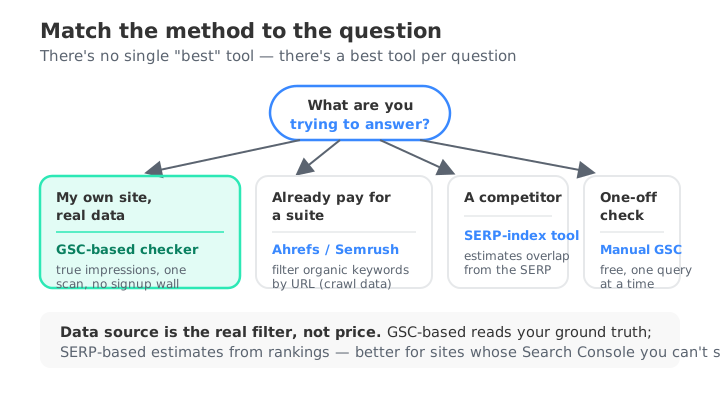
Yes — several, with real differences. The manual Search Console method is free forever and reads your true data, but it's one query at a time. Among automated options, the fastest true-data route is a GSC-connected checker that scans your whole property at once with no card and no keyword cap; SERP-similarity tools also offer free tiers but usually behind an email wall and with lower accuracy on your own site because they estimate from the SERP. So "free" isn't the useful filter — method is. Pick GSC-based when the question is about your own pages; pick SERP-based when the question is about someone else's.
What is the best keyword cannibalization tool?
There's no single winner — there's a best tool per question. To find clashes on your own site from real data, fastest: a GSC-based checker. To analyze a competitor or work inside a suite you already pay for: Ahrefs or Semrush. To learn the method or run a one-off with zero tools: manual Search Console. Match the method to the question and any of these is "best"; grab one at random and you'll either drown in false positives or pay for capability you don't need.
FAQ
What is the best keyword cannibalization tool? It depends on the question. For clashes on your own site from real impression data, a GSC-based checker is fastest and most accurate. For competitor analysis or if you already pay for a suite, Ahrefs or Semrush. For a free one-off, the manual Search Console method.
Is there a free tool to check keyword cannibalization? Yes. The manual Search Console method is free forever, and several automated tools offer free tiers. The most accurate free route for your own site is a GSC-connected checker that reads your real impressions rather than estimating from the SERP.
GSC-based or SERP-based — which is better? GSC-based reads your true impression and position data, so it's better for auditing your own site. SERP-based estimates overlap from ranking similarity, which is better for analyzing a competitor whose Search Console you can't access.
Do I need a paid tool for cannibalization? No. Detection is fully possible for free with Search Console or a GSC-connected checker. Paid suites add value mainly when you already use them for broader SEO work.
The honest bottom line: match the detection method to your question. If that question is "which of my own pages are competing right now," start with a free keyword cannibalization checker that reads your real Search Console data — you'll have the answer before most tools finish asking for your email.
Run a free cannibalization check