Low-Hanging Fruit SEO: What It Is and How to Win It
What low-hanging fruit SEO actually means, the difficulty-and-volume rubric that separates real quick wins from noise, and the tactics that turn them into traffic.
Written by Sebastian Kinzlinger, Founder, Keylogs
· · 8 min read
On this page
Low-hanging fruit SEO is the practice of chasing the wins you're closest to earning — keywords where low competition and existing relevance mean a small push, not a months-long campaign, moves the needle. Instead of targeting head terms from scratch, you prioritize by difficulty and reachability so effort turns into traffic fast.
That's the whole idea in one paragraph. The catch is that "easy win" is one of the most abused phrases in SEO, and most advice never defines it past "look for keywords you can rank for." This post does: what actually qualifies as low-hanging fruit, the rubric that separates it from wishful thinking, and the specific tactics that convert it. It's the concept and strategy side. When you're ready for the exact step-by-step process of pulling these from your own data, the companion guide on how to find low-hanging fruit keywords walks the filters and scoring end to end.
What is low-hanging fruit in SEO?
Low-hanging fruit in SEO is any ranking opportunity where the gap between where you are and where you want to be is small enough that a modest, well-aimed effort closes it. It's a relative measure, not an absolute one: a keyword that's low-hanging fruit for an established site with topical authority might be a six-month slog for a brand-new domain. The fruit is "low" because you are already tall enough to reach it — not because the keyword is inherently easy for everyone.
Practically, that means two families of opportunity. The first is keywords you already rank for but haven't cashed in — sitting on page two, or on page one below the clicks. The second is keywords you don't rank for yet but face weak, thin, or outdated competition that your existing authority can beat. Both share the same trait: the payoff is close to the effort, so the return-on-work ratio is unusually good.
What makes a keyword low-hanging fruit
Three conditions have to hold at once. Drop any one and you've got a keyword that merely looks reachable.
- Low difficulty. The SERP isn't wall-to-wall high-authority domains. If page one is DR-30 blogs, forums, and outdated posts, that's a soft SERP you can break into. If it's Wikipedia, Amazon, and three publications with a million backlinks each, it isn't low-hanging — walk away.
- Decent, real volume. Enough search demand to be worth the work. "Decent" is relative to your site — a 90-searches-a-month term with clear buying intent can beat a 5,000-searches-a-month informational term you'd have to fight for. What you're avoiding is the zero-volume trap: a keyword nobody searches is easy to rank for and worthless.
- Clear, matchable intent. You can tell exactly what the searcher wants and you can serve it with the page type they expect. A keyword whose SERP is all product listings is not low-hanging fruit for your blog post, however weak the competition looks.
Plot those two axes — difficulty against volume — and the sweet spot is the upper-left corner: low difficulty, decent volume, with intent you can match.
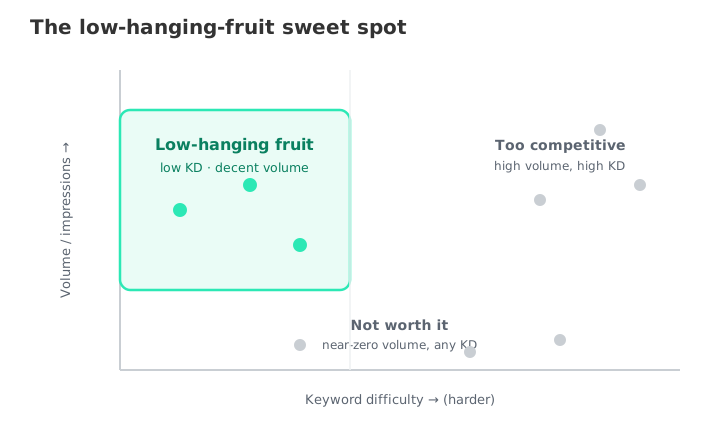
The fastest way to see this for your own site is to start from data you already own rather than a keyword tool full of terms you've never touched. The SEO low-hanging fruit finder reads your Search Console history and surfaces the keywords that already meet the reachability half of this rubric — the ones you rank for but haven't won — so you're scoring real opportunities instead of guessing at a keyword database.
6 low-hanging fruit SEO tactics
Once you know what qualifies, winning it comes down to a handful of repeatable moves. None of these is exotic; the discipline is doing the reachable ones first.
1. Cash in your striking-distance keywords
Your single richest vein is the terms you already rank for in positions 11–30 — one page back from the traffic. Google already considers you relevant; you just haven't earned the top slots yet. These striking distance keywords usually move with a focused on-page pass plus a few internal links using the keyword as anchor text. Start here every time: the demand is proven and the distance is short.
2. Answer the long-tail and PAA questions
Head terms are crowded; the specific questions underneath them often aren't. Pull the "People Also Ask" questions and long-tail modifiers around your topic and give each a crisp, direct answer — a dedicated section or a short supporting page. These queries have lower volume individually but soft SERPs and high intent, and they add up. They're also the terms most likely to earn a featured snippet or an AI-Overview citation.
3. Target competitor weak spots
Look at the keywords your competitors rank for on thin, outdated, or poorly-matched pages. A 2022 listicle with no updates, a 400-word answer to a question that deserves 900, a page targeting the wrong intent — each is a soft spot. If you can publish the genuinely better resource and you already hold comparable authority, that's low-hanging fruit hiding on someone else's site.
4. Fix the snippet on high-impression, low-CTR pages
Some of the fastest wins involve no ranking change at all. Find pages ranking in positions 1–5 that pull far fewer clicks than their position should earn — the ranking is fine, the title and meta description are losing the click. Rewrite the title to be the most clickable result on the SERP (a number, a year, a concrete benefit) and CTR can climb within days, with no re-indexing wait. This is the highest effort-to-payoff tactic on the list.
5. Add internal links to your near-page-one pages
Pages sitting at the bottom of page one are often just under-linked. Point three to five internal links at them from relevant, authoritative pages on your own site, using the target keyword as the anchor. It's the cheapest ranking lever you control outright, and it compounds — it's also the exact fix that pushes striking-distance terms over the line.
6. Refresh decaying content
A page that used to rank and has slipped isn't a lost cause — it's a warm opportunity. Google already trusted it once. Update the facts, expand the thin sections, re-match the current intent, and re-publish. Recovering a page from position 12 back to 5 is almost always faster than ranking something new.
Whichever tactic you pick, change one thing at a time on a given page and note the date you shipped it. Low-hanging fruit moves fast enough that you can see what worked — but only if you didn't rewrite the title, add links and expand the content in the same afternoon. Request indexing in Search Console's URL Inspection tool to speed up the recrawl, give it two weeks, and if the position hasn't moved, add three to five internal links before reaching for anything bigger.
What KD counts as low-hanging fruit?
There's no universal number, because keyword-difficulty scores are relative to your site's authority — but as a working rule, treat KD 0–20 as low-hanging fruit for most sites, KD 20–40 as reachable if you already have topical authority in the area, and KD 40+ as a real campaign rather than a quick win. Pair the score with a manual SERP check: difficulty tools estimate competition from backlink profiles, but they can't see that page one is thin, off-intent, or stale — which is exactly where the easiest wins hide. When the number says "medium" but the SERP looks beatable, trust the SERP.
How do I find low-hanging fruit keywords?
The reliable way is to mine your own Google Search Console data rather than a generic keyword database — because your GSC already knows which keywords send you impressions and where each one ranks, which is half the reachability test done for you. The short version: pull your queries, strip branded terms, filter to positions 4–30, and sort by impressions. That's the process, and it deserves its own walkthrough: the full method — the exact filters, the scoring that matters, and the four opportunity buckets — lives in how to find low-hanging fruit keywords. This post is the "what and why"; that one is the "how."
Where low-hanging fruit fits in a wider routine
Low-hanging fruit SEO isn't a one-off audit — it's a habit. Once you've cleared the obvious wins, the same Search Console data powers an ongoing 15-minute quick-wins routine you can run weekly. The point of leading with reachable keywords isn't to avoid ambitious work forever; it's to bank momentum and traffic now, while the harder content projects mature in the background.
FAQ
What is low-hanging fruit in SEO? Ranking opportunities where the gap between your current position and a winning one is small — keywords you already rank for below the clicks, or terms with weak, beatable competition your existing authority can overtake with modest effort.
What are low-hanging fruit keywords? Keywords that satisfy three conditions at once: low difficulty (a soft SERP), decent real search volume, and clear intent you can match with the right page type. Miss any one and it isn't actually low-hanging.
What KD counts as low-hanging fruit? Roughly KD 0–20 for most sites, and up to KD 40 if you already have topical authority in that area — but always sanity-check the score against the live SERP, since difficulty tools can't see a thin or outdated page one.
Is low-hanging fruit SEO worth doing if my site is new? Yes, but your fruit hangs lower on long-tail and question keywords with genuinely weak SERPs — a brand-new domain won't out-authority established competitors, so start with the specific, low-competition terms and build up.
Low-hanging fruit SEO is really just prioritization with a rule attached: do the reachable, decent-volume, matchable-intent work first. The rubric keeps you honest about what "reachable" means; the tactics turn it into traffic. When you'd rather skip the spreadsheet, the SEO low-hanging fruit finder runs the whole reachability pass on your Search Console data in under a minute and hands back the keywords already sitting in the sweet spot.
Find your low-hanging fruit — free